Shopy 101
← Prerrequisitos 2 İndirmek için giriş yap
Introducción 1 Prerrequisitos 2 Balances 3
Operaciones Básicas

Además de los conceptos matemáticos y físicos básicos para abordar un texto de estas características, vamos a hacer hincapié en el estudio de las herramientas básicas de la ingeniería: el análisis dimensional y los sistemas de unidades. El resto de prerrequisitos se intentarán enlazar con otros wikilibros en lo posible, o con enlaces a páginas externas.

Factores de conversión

Para asegurarnos de que los conoces, haremos un repaso a la siempre útil herramienta de los factores de conversión.

\\mbox{Lo que quieres} = \\mbox{Lo que tienes} \\times \\frac{\\mbox{Lo que quieres}}{\\mbox{Lo que tienes}}</math>"}},"i":0}}]}'>

{\displaystyle {\mbox{Lo que quieres}}={\mbox{Lo que tienes}}\times {\frac {\mbox{Lo que quieres}}{\mbox{Lo que tienes}}}}

Donde la fracción se obtiene de tablas de conversión.

bars = 800\\mbox{ mmHg}\\times\\frac{1.013\\mbox{ bar}}{760\\mbox{ mmHg}} = 1.066\\mbox{ bar} </math>\n\nUsing the tables from Wikipedia, you need to convert to an ''intermediate'' (the metric unit) and then convert from the intermediate to the desired unit. We would find that \n\n<math> 1 \\mbox{ mmHg}=133.322\\mbox{ Pa} </math> and <math>1\\mbox{ bar}=10^5\\mbox{ Pa}</math>\n\nAgain, we have to set it up using the same general form, just we have to do it twice:\n\n<math> bars = 800\\mbox{ mmHg}*\\frac{133.322\\mbox{ Pa}}{1\\mbox{ mmHg}}*\\frac{1\\mbox{ bar}}{10^5\\mbox{ Pa}} = 1.066\\mbox{ bar}</math>"}},"i":0}}]}'>
Icono de ejercicio
ejercicio

Ejercicio
Pasar una presión de 800 mmHg a bares

Solución

If you wanted to convert 800 mmHg to bars, using the horizontal list, you could do it directly:

{\displaystyle bars=800{\mbox{ mmHg}}\times {\frac {1.013{\mbox{ bar}}}{760{\mbox{ mmHg}}}}=1.066{\mbox{ bar}}}

Using the tables from Wikipedia, you need to convert to an intermediate (the metric unit) and then convert from the intermediate to the desired unit. We would find that


{\displaystyle 1{\mbox{ mmHg}}=133.322{\mbox{ Pa}}} and {\displaystyle 1{\mbox{ bar}}=10^{5}{\mbox{ Pa}}}

Again, we have to set it up using the same general form, just we have to do it twice:

{\displaystyle bars=800{\mbox{ mmHg}}*{\frac {133.322{\mbox{ Pa}}}{1{\mbox{ mmHg}}}}*{\frac {1{\mbox{ bar}}}{10^{5}{\mbox{ Pa}}}}=1.066{\mbox{ bar}}}

Análisis dimensional

P = g*h </math>\nDonde P es presión hidrostática, g la aceleración de la gravedad y h la altura del fluído."},"solución":{"wt":"We could check this equation by plugging in our units:\n\n<math>P \\dot= M/(L*t^2) \\mbox{ , } h \\dot= L \\mbox{ , } g \\dot= L/t^2 </math> <br>\n<math>g * h \\dot= L^2/t^2 \\neq M/(L*t^2) </math> <br>\n\nSince g*h doesn't have the same units as P, the equation must be wrong ''regardless of the system of units we are using!'' The correct equation, in fact, is:\n\n<math> P = \\rho*g*h </math> <br>\nwhere <math> \\rho </math> is the density of the fluid. Density has base units of <math> M/L^3</math> so \n\n<math> \\rho*g*h \\dot= L^2/t^2 * M/L^3 \\dot= M/(L*t^2)</math> which are the units of pressure. <br>\n\nThis does not tell us the equation is correct but it ''does'' tell us that the units are consistent, which is necessary though not sufficient to obtain a correct equation. ''This is a useful way to detect algebraic mistakes that would otherwise be hard to find.'' The ability to do this with an algebraic equation is a good argument against plugging in numbers too soon!"}},"i":0}}]}'>
Icono de ejercicio
ejercicio

Ejercicio
Analiza la consistencia dimensional de esta ecuación: {\displaystyle P=g*h} Donde P es presión hidrostática, g la aceleración de la gravedad y h la altura del fluído.

Solución

We could check this equation by plugging in our units:

{\displaystyle P{\dot {=}}M/(L*t^{2}){\mbox{ , }}h{\dot {=}}L{\mbox{ , }}g{\dot {=}}L/t^{2}}
{\displaystyle g*h{\dot {=}}L^{2}/t^{2}\neq M/(L*t^{2})}

Since g*h doesn't have the same units as P, the equation must be wrong regardless of the system of units we are using! The correct equation, in fact, is:
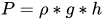
{\displaystyle P=\rho *g*h}
where {\displaystyle \rho } is the density of the fluid. Density has base units of {\displaystyle M/L^{3}} so

{\displaystyle \rho *g*h{\dot {=}}L^{2}/t^{2}*M/L^{3}{\dot {=}}M/(L*t^{2})} which are the units of pressure.

This does not tell us the equation is correct but it does tell us that the units are consistent, which is necessary though not sufficient to obtain a correct equation. This is a useful way to detect algebraic mistakes that would otherwise be hard to find. The ability to do this with an algebraic equation is a good argument against plugging in numbers too soon!

Unidades

Wikipedia Para más información, véase el artículo «Unidad de medida» en Wikipedia.

Los sistemas de unidades empleados en Ingeniería Química se reducen principalmente al Sistema Internacional de unidades. Sin embargo, para aplicaciones específicas pueden encontrarse con los sistemas CGS y MKS. Además, como ésta rama tuvo un importante desarrollo en los países anglosajones también es común el sistema británico. En el libro usaremos por defecto el SI, y recomendamos que sea este el que uses en tu labor cotidiana. Las definiciones específicas puedes encontrarlas en la Wikipedia: SI.

Enlaces externos

  • Conceptos básicos de matemáticas (álgebra de sistemas, derivar, integrar, etc.)
  • Conceptos básicos de física (termodinámica, mecánica clásica, etc.)
  • Conceptos básicos de química (mol, peso molecular, formas de concentración, etc.)
  • Conversor de unidades


