- Introduction
- Different Types of Data
- Methods of Data Collection
- Data Analysis
- Summary Statistics
- Displaying Data
- Probability
- Distributions
- Testing Statistical Hypothesis
- Purpose of Statistical Tests
- Formalism Used
- Different Types of Tests
- z Test for a Single Mean
- z Test for Two Means
- t Test for a single mean
- t Test for Two Means
- paired t Test for comparing Means
- One-Way ANOVA F Test
- z Test for a Single Proportion
- z Test for Two Proportions
- Testing whether Proportion A Is Greater than Proportion B in Microsoft Excel
- Spearman's Rank Coefficient
- Pearson's Product Moment Correlation Coefficient
- Chi-Squared Tests
- Approximations of distributions
- Point Estimates </span> as of 12:07, 28 March 2007 (UTC)"}'>
 (12:07, 28 March 2007 (UTC))
- Unbiasedness
- Measures of goodness
- UMVUE
- Completeness
- Sufficiency and Minimal Sufficiency
- Ancillarity
- Practice Problems
- Numerical Methods
- Time Series Analysis
- Multivariate Data Analysis
- Analysis of Specific Datasets
- Appendix

Harmonic Mean
The arithmetic mean cannot be used when we want to average quantities such as speed.
Consider the example below:
Example 1: The distance from my house to town is 40 km. I drove to town at a speed of 40 km per hour and returned home at a speed of 80 km per hour. What was my average speed for the whole trip?.
Solution: If we just took the arithmetic mean of the two speeds I drove at, we would get 60 km per hour. This isn't the correct average speed, however: it ignores the fact that I drove at 40 km per hour for twice as long as I drove at 80 km per hour. To find the correct average speed, we must instead calculate the harmonic mean.
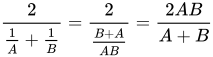
For two quantities A and B, the harmonic mean is given by:

This can be simplified by adding in the denominator and multiplying by the reciprocal:
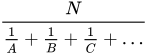
For N quantities: A, B, C......
Harmonic mean =
Let us try out the formula above on our example:
Harmonic mean =

Our values are A = 40, B = 80. Therefore, harmonic mean

Is this result correct? We can verify it. In the example above, the distance between the two towns is 40 km. So the trip from A to B at a speed of 40 km will take 1 hour. The trip from B to A at a speed to 80 km will take 0.5 hours. The total time taken for the round distance (80 km) will be 1.5 hours. The average speed will then be 
The harmonic mean also has physical significance.