- Introduction
- Different Types of Data
- Methods of Data Collection
- Data Analysis
- Summary Statistics
- Displaying Data
- Probability
- Distributions
- Testing Statistical Hypothesis
- Purpose of Statistical Tests
- Formalism Used
- Different Types of Tests
- z Test for a Single Mean
- z Test for Two Means
- t Test for a single mean
- t Test for Two Means
- paired t Test for comparing Means
- One-Way ANOVA F Test
- z Test for a Single Proportion
- z Test for Two Proportions
- Testing whether Proportion A Is Greater than Proportion B in Microsoft Excel
- Spearman's Rank Coefficient
- Pearson's Product Moment Correlation Coefficient
- Chi-Squared Tests
- Approximations of distributions
- Point Estimates </span> as of 12:07, 28 March 2007 (UTC)"}'>
 (12:07, 28 March 2007 (UTC))
- Unbiasedness
- Measures of goodness
- UMVUE
- Completeness
- Sufficiency and Minimal Sufficiency
- Ancillarity
- Practice Problems
- Numerical Methods
- Time Series Analysis
- Multivariate Data Analysis
- Analysis of Specific Datasets
- Appendix

Combinatorics studies permutations and combinations of objects chosen from a sample space. A preliminary knowledge of combinatorics is necessary for a good command of statistics.
Counting Principle
The Counting Principle is similar to the Multiplicative Principle. If a process involves 



Permutations
A permutation is a distinct arrangement of 

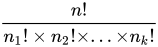

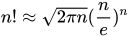
When faced with very large factorials, a useful approximation is Stirling's formula:
Now suppose we only choose r distinct elements from the set (without replacement). Then the number of possible permutations becomes 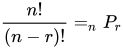
Combinations
A combination is essentially a subset. It is like a permutation, except with no regard to order. Suppose we have a set of 

Note also that
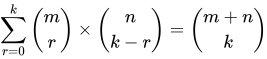
Combinations are found in binomial expansion. Consider the following binomial expansions:




As you may have noticed from the above, for any positive integer
![{\displaystyle (x+y)^{n}=\sum _{i=0}^{n}[\displaystyle {n \choose r}\times x^{n-r}\times y^{r}]}](https://wikimedia.org/api/rest_v1/media/math/render/svg/388fc237eb70720bf99c1e501b6865074f21b9a9)
Another observation from the above is known as Pascal's law. It states that
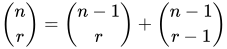
This allows us to construct Pascal's triangle, which is useful for determining combinations:
