About
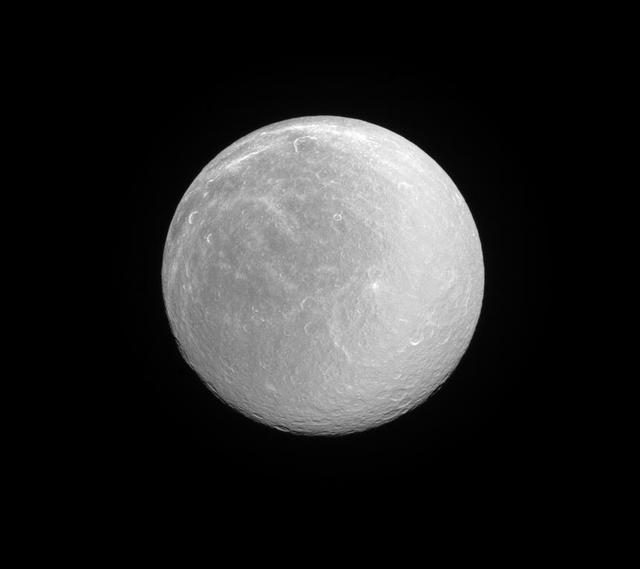
Rhea, like many moons in the outer solar system, appears dazzlingly bright in full sunlight. This is the signature of the water ice that forms most of the moon's surface. Rhea (949 miles or 1,527 kilometers across) is Saturn's second largest moon after Titan. Its ancient surface is one of the most heavily cratered of all of Saturn's moons. Subtle albedo variations across the disk of Rhea hint at past geologic activity. This view looks toward the anti-Saturn hemisphere of Rhea. North on Rhea is up and rotated 36 degrees to the right. The image was taken with the Cassini spacecraft narrow-angle camera on June 3, 2016 using a spectral filter which preferentially admits wavelengths of ultraviole — NASA JPL · 2016. ABD devlet eseri: kamu mali, ticari islerde de serbestce kullanilabilir.
Source and licence
This work is public domain or openly licensed. The licence terms are published by the source.
How do I open it?
Use the Shopy 101 app to download it or read it in place. Anything you add to your library stays the same on every device.