About
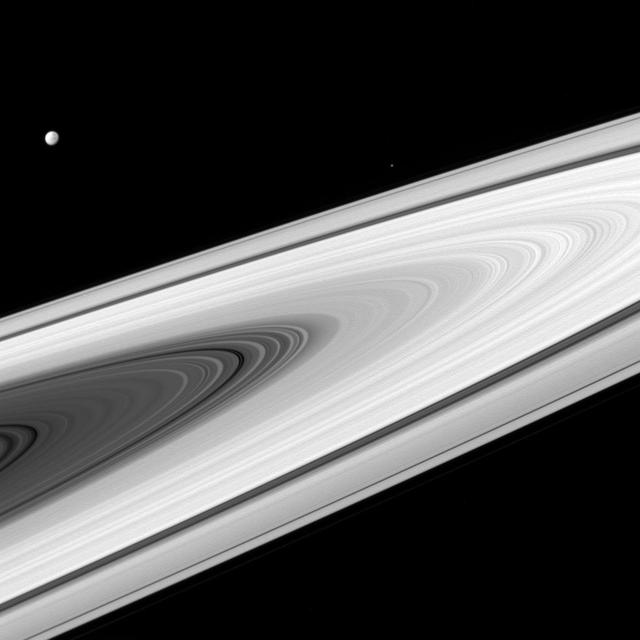
Saturn's main rings, along with its moons, are much brighter than most stars. As a result, much shorter exposure times (10 milliseconds, in this case) are required to produce an image and not saturate the detectors of the imaging cameras on NASA's Cassini spacecraft. A longer exposure would be required to capture the stars as well. Cassini has captured stars on many occasions, especially when a target moon is in eclipse, and thus darker than normal. For example, see PIA10526 . Dione (698 miles, 1123 kilometers across) and Epimetheus (70 miles, 113 kilometers across) are seen in this view, above the rings at left and right respectively. This image looks toward the sunlit side of the rings fro — NASA JPL · 2016. ABD devlet eseri: kamu mali, ticari islerde de serbestce kullanilabilir.
Source and licence
This work is public domain or openly licensed. The licence terms are published by the source.
How do I open it?
Use the Shopy 101 app to download it or read it in place. Anything you add to your library stays the same on every device.