About
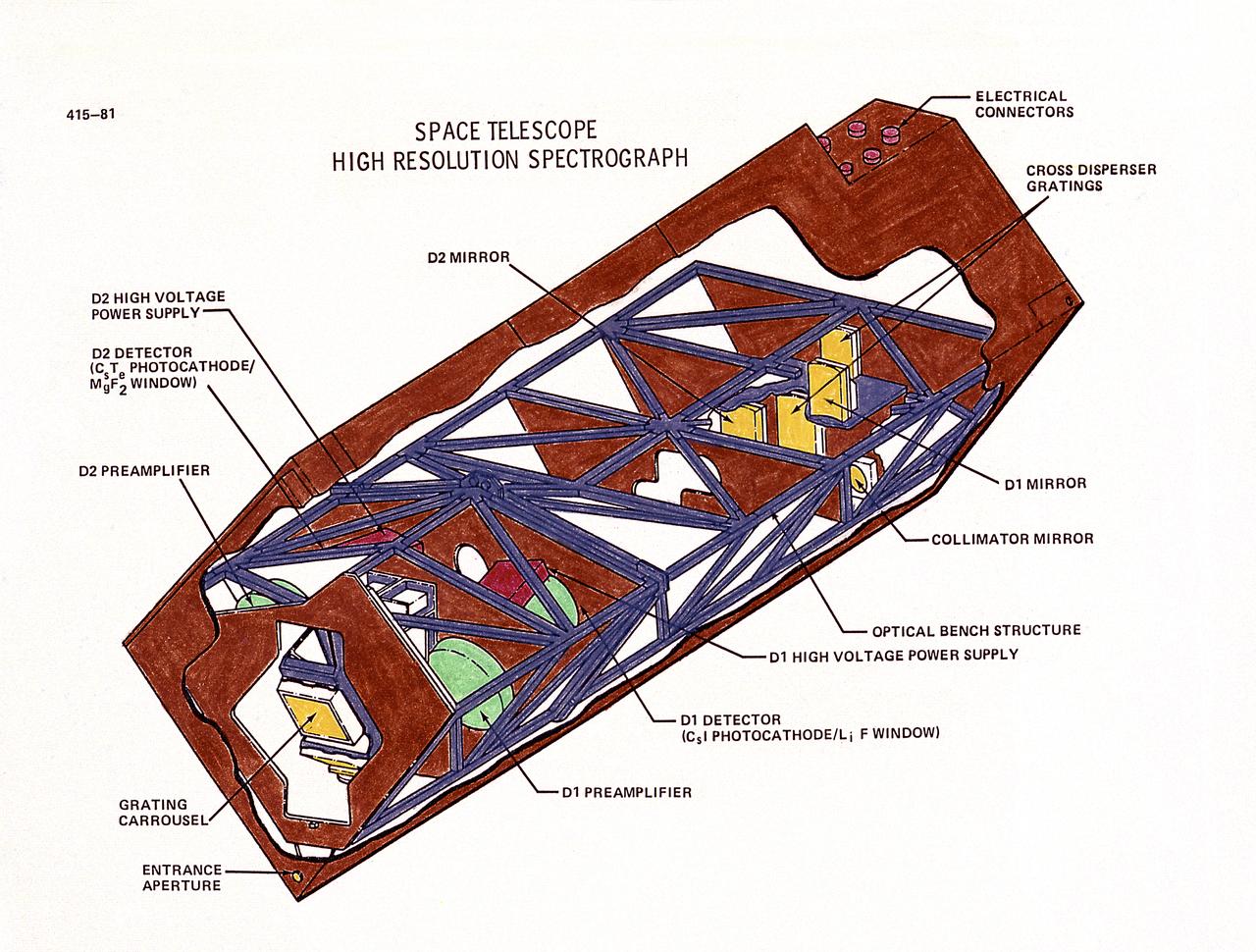
This drawing illustrates the Hubble Space Telescope's (HST's), Goddard High-Resolution Spectrograph (GHRS). The HST's two spectrographs, the GHRS and the Faint Object Spectrograph (FOS), can detect a broader range of wavelengths than is possible from Earth because there is no atmosphere to absorb certain wavelengths. Scientists can determine the chemical composition, temperature, pressure, and turbulence of the stellar atmosphere producing the light, all from spectral data. The GHRS can detect fine details in the light from somewhat brighter objects but only ultraviolet light. Both spectrographs operate in essentially the same way. The incoming light passes through a small entrance aperture, — NASA MSFC · 1981. ABD devlet eseri: kamu mali, ticari islerde de serbestce kullanilabilir.
Source and licence
This work is public domain or openly licensed. The licence terms are published by the source.
How do I open it?
Use the Shopy 101 app to download it or read it in place. Anything you add to your library stays the same on every device.